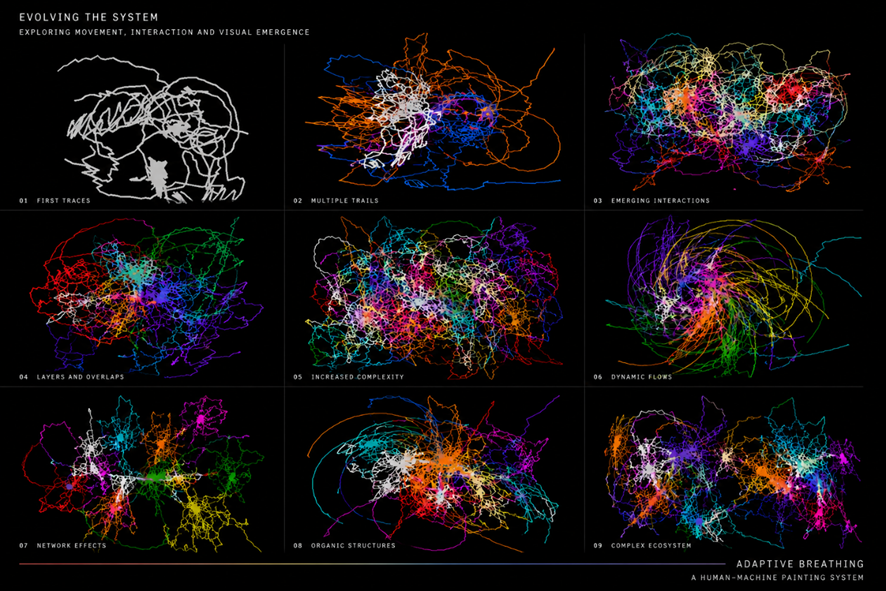
Adaptive Breathing
A Human-Machine painting system, a curatorial statement
Adaptive Breathing investigates how images can emerge from negotiation rather than control. Instead of treating technology as either a passive tool or an autonomous author, the project proposes a shared perceptual system in which embodied movement and computational perception continuously influence one another.
The work is built around a custom human–machine painting system that translates juggling into a living visual process. Using a custom computer vision engine based on OpenCV, multiple coloured juggling objects are tracked in real time and interpreted according to a set of behavioural rules developed specifically for this work. Rather than relying on pre-trained image generators or prompt-based production, the system establishes its own perceptual logic through movement, memory and transformation. Each colour contributes differently to an evolving composition, producing a visual counterpoint between bodily precision and algorithmic interpretation.
The generated image is not the final artwork but the beginning of a second translation. Once the digital composition reaches its final state, it is immediately printed in multiple A5 editions and arranged around a large canvas placed on the floor. The performer then recreates the virtual image as a physical painting using pigment and bouncing balls that burst and scatter paint across both the canvas and the printed images.
This final gesture introduces another stage of adaptation. The digital image encounters gravity, matter and chance; computational interpretation gives way to physical unpredictability. Audience members are invited to take one of the painted prints with them, each preserving a unique fragment of the encounter between digital generation and material intervention.
Adaptive Breathing understands adaptation not as submission to existing technological systems, but as the construction of a new perceptual framework. Rather than asking a machine to imitate human creativity, the project builds an alternative image-making process in which human and computational perception remain distinct while producing something neither could create independently.
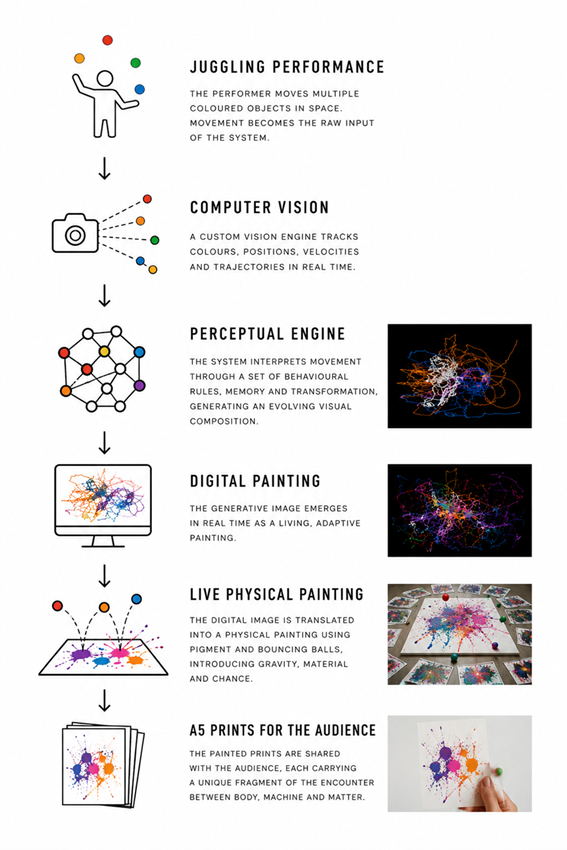
Adaptive Breathing is a human–machine painting system in which juggling performance becomes a visual negotiation between embodied movement and a custom perceptual engine, producing both a live generative image and a final physical painting.
The system observes the performance through computer vision, identifying each juggling object according to its colour, position, velocity and trajectory. Rather than simply reproducing those paths as drawings, it interprets movement through a set of behavioural rules developed specifically for the project. Slow movements may generate broader marks, rapid accelerations may produce thinner or more fragmented lines, while changes in rhythm and interaction between objects continuously transform the composition.
As additional juggling objects enter the performance, the system does not restart the image. Instead, it incorporates each new stream of information into an evolving visual memory. Every colour contributes a different behaviour, allowing the painting to develop through accumulation, interaction and adaptation rather than through simple trajectory mapping.
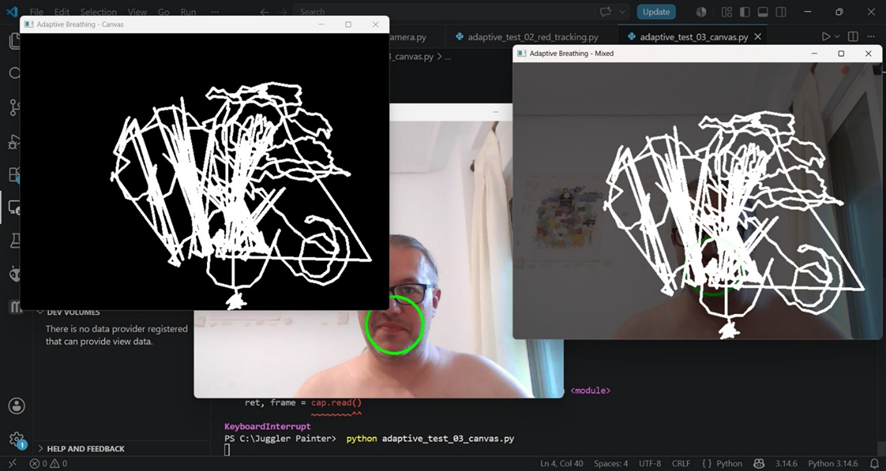
The images below document the earliest stage of development. The first prototype successfully detects a single coloured object and records its movement on a digital canvas. During testing, the system occasionally misidentifies parts of the performer’s face as juggling objects, revealing both the limitations and the creative potential of machine perception. The three windows show the generated canvas, the live camera feed, and a composite view in which both layers are superimposed.
The software has been developed in Python using OpenCV as the computer vision framework. The following experiments explore the transition from single-object tracking toward multiple objects, independent behaviours and increasingly complex interactions, laying the foundation for the perceptual engine that will generate the final paintings.